 Bryan Barrett
If your SaaS product is mostly a familiar workflow behind a familiar interface, assume someone can copy what they can see faster than the old SaaS playbook expects.
Features still matter. Software companies can still be defensible. But the advantage is moving from what the market can inspect to what the product earns by being used.
That word matters: earns.
A product doesn't earn a data advantage because it stores customer records, watches users click around, or saves every prompt. It earns one when customers trust it with recurring real work, when it captures permissioned patterns from that work, and when those patterns change what the product does next.
Those patterns change how the product behaves in ways a competitor never sees. A support tool learns which ticket phrasing resolves without a human and which needs to escalate early. A fraud product learns which transaction shapes deserve a second look before they clear. A billing product learns the safe default for a new account, the review depth a given customer expects, the personalization that makes a workflow stick. None of that shows up in a demo, because none of it exists until customers have run real work through the product for months.
Think about what's actually on display. The workflow, the UI pattern, the onboarding flow, the pricing page, the integration list, the promise on the homepage. Increasingly, the AI capability underneath a feature is infrastructure a competitor can rent through public APIs and published pricing (OpenAI; Anthropic).
So the SaaS defensibility question changes.
The old question was: "What feature can we build that others cannot?"
The better one: "What does our product offering unique because customers keep using it?"
Product-earned data isn't a scraped corpus, someone else's API, a pile of saved prompts, or a dashboard full of vanity activity. It's the permissioned learning record created through real use over time, tied to customer-visible results the product can use to make a better future decision.
The visible feature is the layer competitors can study
Investors and founders keep circling back to wrapper risk, and they're right to. Early LLM application architecture was often assembled from common parts: orchestration, retrieval, model APIs, vector stores, and app frameworks (a16z). That shared architecture is genuinely useful. It also means the first version of many visible features is rarely the hard part.
The market is starting to price this in. Investors have cooled on thin workflow layers and looked more seriously at vertical SaaS, proprietary data, and systems of action (TechCrunch). Bain frames SaaS workflow exposure around how observable, standardized, shallow-data, and low-friction a workflow is (Bain).
Here's the founder version.
A visible feature creates a demo advantage. A product-earned data loop creates a longitudinal decision advantage.
A competitor can study the first. It has to earn the second.
That's the difference between a feature and an advantage.
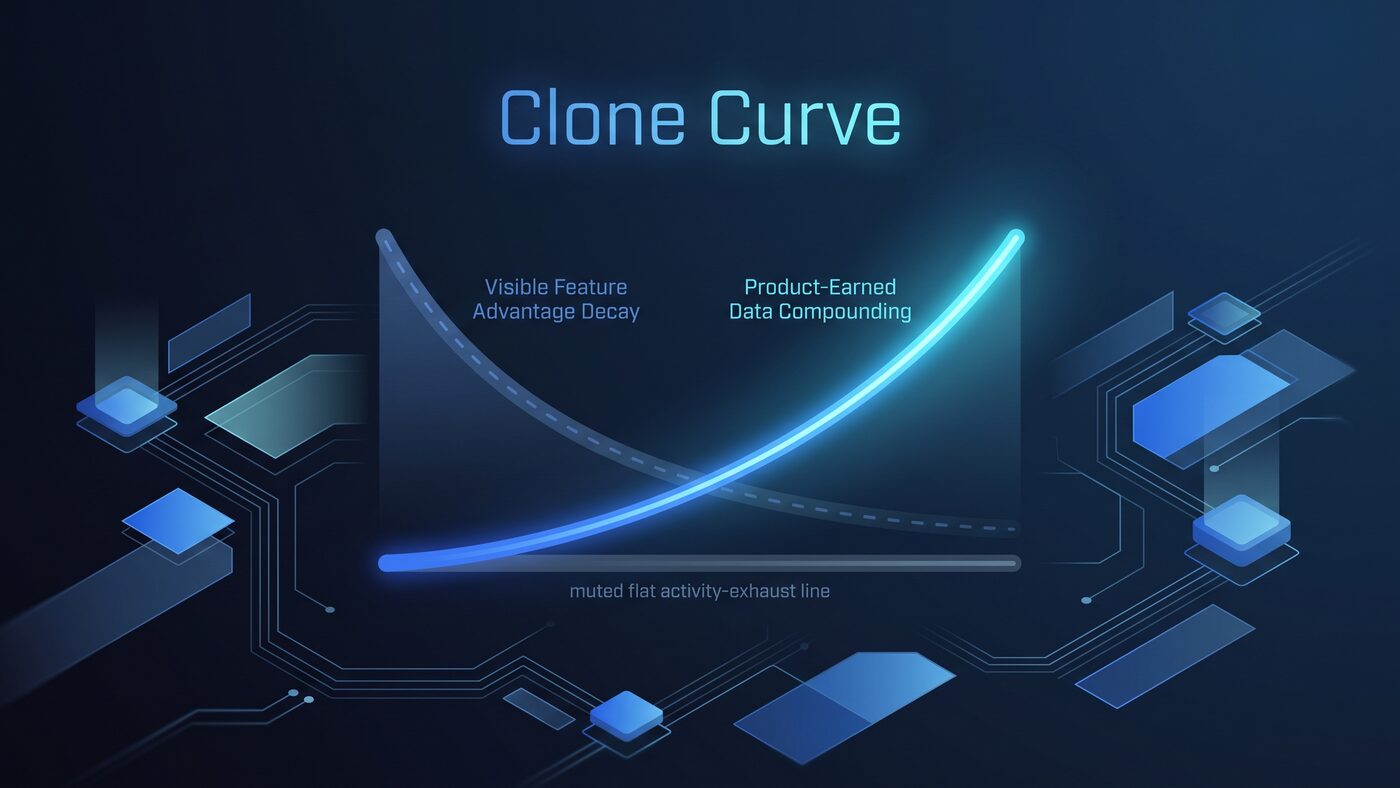
The visible-feature advantage decays as capability turns into rentable infrastructure, while the product-earned-data advantage compounds with use. Raw activity logs stay flat.
Owned data is not the same as earned data
"Proprietary data" is a comforting phrase, but it's too broad to tell you what to build.
A PDF archive can be proprietary. So can a customer database, or a stack of support transcripts. None of that automatically makes the product better. Data starts to matter only when it's tied to a decision the product makes and a result the customer can feel.
Vertical software investors make a similar argument: proprietary data only matters when it is paired with domain depth, integration, economic value, and product use (Bessemer; Flybridge; TechCrunch).
So set the bar higher than "we have data."
Product-earned data should pass five tests:
- It is created by repeated real usage, not bought wholesale.
- It is permissioned for the use the strategy depends on.
- It captures customer-visible results, not just activity.
- It changes a product decision.
- It is hard for a competitor to reconstruct from the outside.
That last test is the one that bites. A competitor can copy your marketing copy, your UI, your positioning, and a fair number of your workflow assumptions. What it can't instantly copy is a longitudinal record of what happened across real customer work: where the product helped, where it got ignored, what changed the customer's result, and which decisions led to better outcomes.
How to tell whether the advantage is real
If you're evaluating a SaaS company, don't stop at the demo. Ask what the product earns after the sale.
Then ask:
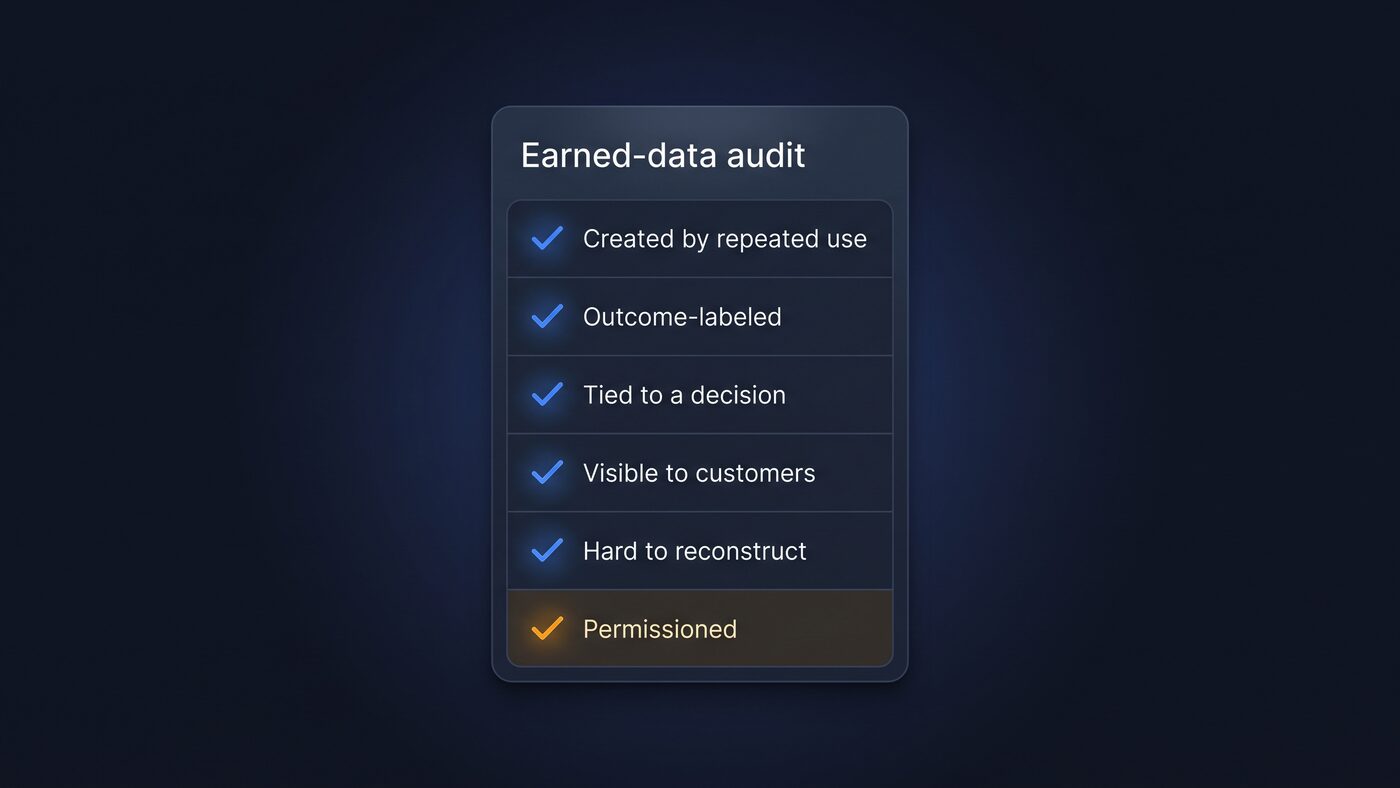
The audit separates earned data from generic usage exhaust.
- What data is created only after repeated real usage?
- Did the customer trust the product with real recurring work, or did the data come from a one-time import?
- Is the data permissioned for the way the product uses it?
- Does it capture customer-visible results, or is it just activity?
- Which product decision does it improve?
- Can the customer perceive the improvement?
- Can a competitor reconstruct it from public data, onboarding questions, or a few demos?
- Does it compound across customers, within a customer, or only inside one narrow workflow?
- Does more data keep helping, or does it hit diminishing returns quickly?
- What failure modes are captured and corrected?
- What stays human-gated no matter how much evidence accumulates?
The best answers are specific.
Weak: "We learn from usage." Strong: "Every recurring use gives the product a clearer signal about which route, review depth, escalation path, default, or personalization choice works next time."
"We have proprietary data" tells you nothing on its own. The version that means something is narrower: permissioned data tied to a decision the product makes, where the customer can feel the improvement. And "the product gets better over time" only counts when a founder can name what it gets better at — which patterns lead to better customer results, which cases need escalation, which defaults should change.
The advantage is earned after the sale
AI is eating the old SaaS feature advantage because more of the visible product can now be assembled from common infrastructure, public patterns, and familiar workflows.
That doesn't make SaaS indefensible. It makes defensibility more demanding.
The durable advantage is no longer just what the product can demo. It's what the product earns through use: the permissioned, longitudinal record that helps it make better decisions than a fresh clone can make.
That is the data a competitor cannot scrape from your homepage.
If your product doesn't earn it, your next feature launch may be easier to copy than you think.


